

Case Study
From Fragmented Operations to a Single System of Control.
$1M in Annual Savings at One Location.
Overview
Enterprise Hospitality Group — Multi-Location, High-Volume Operations
Operator
Enterprise hospitality group operating high-volume venues across multiple locations.
Environment
High-volume hospitality operations with complex payment flows, multi-system infrastructure, and high transaction throughput.
Deployment
Full Vitabyte operating platform — infrastructure integration, payment orchestration, unified data and control, automated execution, and real-time intelligence.
The Problem
High-volume hospitality operations depend on speed, accuracy, and control — across every transaction, every shift, and every location.
This group was running on multiple disconnected systems across POS, payments, and reporting. At scale, that fragmentation created compounding operational problems:
Manual reconciliation consumed hours daily.
End-of-day reconciliation across disconnected payment and POS systems required staff to manually match transactions, identify discrepancies, and resolve errors — every night, at every location.
Financial visibility was delayed.
Operators could not see real-time financial performance. Reporting was batch-based, retrospective, and inconsistent across locations. Decisions were made on incomplete data.
Transaction speed was constrained.
In peak-service environments where seconds matter, disconnected payment infrastructure introduced latency that slowed service and reduced throughput during the highest-revenue hours.
Operational overhead increased with every new location.
More reconciliation, more reporting, more coordination across systems that were never designed to work together.
In high-throughput environments, even small inefficiencies compound. Manual reconciliation errors become financial risk. Delayed reporting becomes missed opportunity. Slow transactions become lost revenue.
The Deployment
Vitabyte was deployed as the operating platform across the group's infrastructure.
Not as an add-on tool, but as the system layer that unified payments, operations, and data.
Step 01
Infrastructure Integration
Deep integration with the group's existing POS and operational systems. Vitabyte operates within the infrastructure — certified, deployment-tested, and running in live, high-volume environments.
Step 02
Payment Orchestration
Vitabyte was placed directly in the transaction flow as the payment orchestration layer — unifying in-person payment processing, reconciliation, and financial control across all locations through a single platform.
Step 03
Unified Data & Control
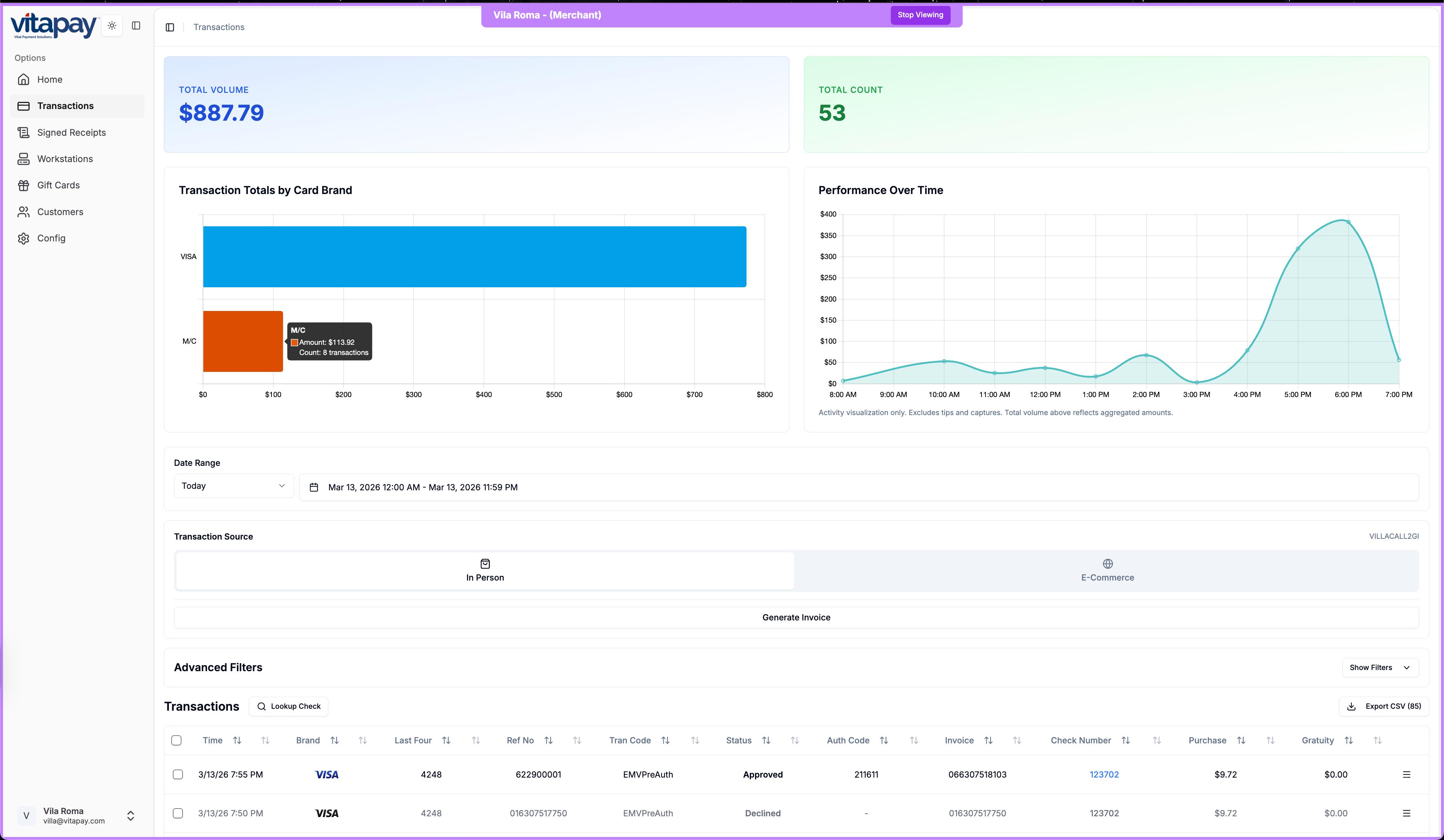
POS, payment, and operational data normalized into a single, real-time system of record. Operators gained a live control layer across every location — replacing fragmented, inconsistent reporting.
Step 04
Automated Execution
Manual reconciliation, financial reporting, and operational coordination workflows were replaced by system-driven execution — running continuously and in real time, without manual intervention.
The platform replaced coordination between systems with a single operational flow.
The Outcomes
Measurable impact. Structural change.
Automated
Reconciliation
Manual end-of-day reconciliation processes eliminated. Reconciliation now runs in real time — continuously, accurately, across all locations. Hours of daily manual work replaced entirely by automated system execution.
~2 Seconds
Transaction Speed
Transaction processing reduced to approximately 2 seconds per interaction at peak locations. In high-volume environments where throughput directly impacts revenue, this speed is operational infrastructure — not a feature.
Reduced
Labor
Automation of financial and operational workflows reduced the labor required for reconciliation, reporting, and cross-system coordination. Staff time redirected from manual processes to service operations.
~$1M
Annual Savings
At a single high-volume location, the combined impact of automated reconciliation, reduced labor, faster transaction processing, and unified financial control resulted in approximately $1M in annual operational savings.
Real-Time
Visibility
End-of-day batch reporting replaced with live operational visibility — financial performance, transaction data, and reconciliation status available in real time, across every location.
What This Proves
This deployment demonstrates what happens when fragmented systems are replaced by a single operating platform.
Manual processes become automated execution.
Delayed reporting becomes real-time control.
Disconnected data becomes a unified system of record.
Operational overhead becomes measurable savings.
The impact is not incremental. It is structural.
This is what happens when operations become a system.